
An adolescent’s perspective of the birth of the IB
in the Greek theatre

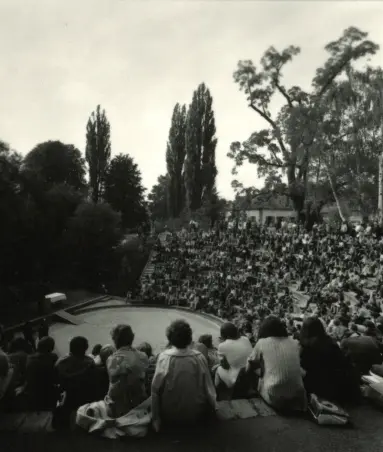
It was my fault, I fear, that my parents missed the historic occasion in the Greek Theatre, on the 24th September 1971, when Lord Mountbatten handed out the very first IB diplomas. I was struck by this realization some years ago when I disturbed a geological stratum in a pile of papers going back to my adolescence, bringing to light the Director General’s invitation: a modestly mimeographed sheet that age has now dignified with the fragility and hue of papyrus. Ecolint’s management at the time assumed that 15-year-olds could be trusted to deliver this document to their parents. A sad error, at least in my case. Far from dutifully taking it home, and inspired by a literary diet of P. G. Wodehouse (whose fiction is populated by indolent, upper-class twits who sponge off aristocratic relatives), I sought to amuse my classmates by circling Mountbatten’s name and scribbling: “My uncle. The old bean owes me ₤20,000, by Jove! That’s the ticket.”
This was an underwhelming display of wit from a student who, that very same academic year, would be embarking on the nascent International Baccalaureate diploma programme (which at the time took two and a half years, and started in the second semester of Year 11). The intention behind the diploma-awarding ceremony was to celebrate the pioneering courage of the educational experiment’s 12 guinea-pigs (who were three years ahead of me) and to inspire the next few cohorts. I wish I could tell you that I and most of my contemporaries were captivated and thrilled by this audacious, home-grown adventure in pedagogy; the sober truth is that all its noble, idealistic underpinnings and ambitions had largely passed us by.
Only two aspects of the IB captured our interest: first, that we would be deciding which subjects to pursue at “Higher Level” and at “Subsidiary Level” (the latter term was eventually deemed derogatory and abolished in favour of “Standard Level”); and second, that the A — F range of grades would be replaced by a 7 — 1 scale. I’m afraid that these two issues (and the second one in particular — a source of endless, petty, futile speculation) pretty much summed up the whole IB project in our eyes, notwithstanding the fact that many of us had the IB’s mastermind, Robert Judson Leach, as our History teacher.
It has to be said that, in those days, Ecolint felt little need to inform and communicate incessantly. There was no conscious attempt to inculcate in students the latest pedagogical theories or rationales; as for parents, they generally trusted the school’s educators to do what was best for their children, and let them get on with it unperturbed. Apart from my three school reports, I don’t think that Ecolint troubled my parents with more than three or four succinct, mailed communiqués per year. True, it would have been nice for them to know about Lord Mountbatten’s presence in advance, but this was one of those unusual cases in which you can safely shoot the messenger.
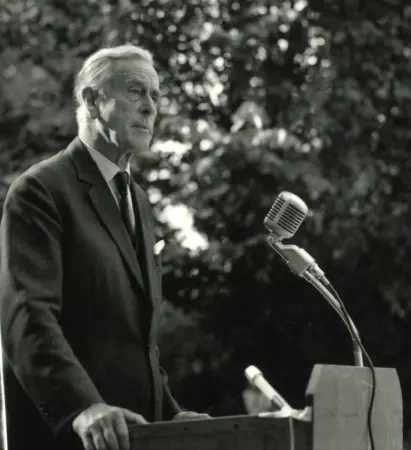
I won’t blame you for concluding that we were a bunch of nincompoops when I confess that the name “Mountbatten” meant little to me and most of my pals. The term “Lord,” however, galvanized us: most of us had never seen one before. It was only when Bernard Reith, a student who was a couple of years our senior, introduced (with a fine speech) the 1st Earl Mountbatten of Burma in the Greek Theatre, that the historical significance of the elegant guest standing next to our no less elegant Director General, René-François Lejeune (héros de la Résistance), began to dawn on us: Supreme Allied Commander in South East Asia during World War II, last Viceroy and first Governor-General of India (who oversaw and facilitated that great nation’s independence), NATO Commander of the Mediterranean Allied Forces, First Sea Lord, Chief of the United Kingdom’s Defence Staff, uncle of Prince Philip (whom he introduced to the future Queen Elizabeth) and mentor of the Prince of Wales… More to the point from Ecolint’s perspective, Mountbatten had agreed to serve as a standard-bearer for the IB, at the request of the International Baccalaureate Organization’s first Director General, the distinguished educator Alec Peterson, who had served as Mountbatten’s aide-de-camp in Burma during the war.
With hindsight, what can I say? If I could relive the experience, I would pay more attention to the historic event unfolding before my eyes. And I’d make sure that my parents (perdón, Mami, perdón, Papi) got the invitation in the first place.
Alejandro Rodríguez-Giovo
Foundation Archivist