
Álvaro de Soto, Former United Nations Under-Secretary-General and diplomat, LGB 1960
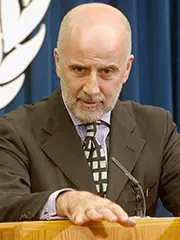 Álvaro de Soto
La Grande Boissière, 1960
Former United Nations Under-Secretary-General & Diplomat
USA
Learn more about me:
- Read Álvaro’s chapter in "Letters to a Young Mediator" (pace Rainer Maria Rilke).
- Read Álvaro’s interview in “Kings Of Peace, Pawns Of War: The Untold Story Of Peacemaking”
- Read Álvaro de Soto's end-of-mission report in the Middle East, upon resigning from the UN after 25 years. Though classified, it was leaked to The Guardian by persons unknown.
Though as I write this I am flying from New York to Seattle to visit my granddaughter, I have been spending a lot of time in Paris of late, writing and enjoying a third career telling Master's level students at Sciences Po about the second, at the UN, where I worked for a quarter-century, doggedly trying to get warring parties to solve their armed conflicts via negotiation. I tell students that this métier has become significantly more difficult since the unwinding of the Cold War (the previous one, not the one we face today). My book is about that, but it is also a bit of a memoir. I am closely associated with two NGOs active in my field. As the pandemic wanes, I dream of visiting (and revisiting) the ruins of ancient civilizations.
My favourite Ecolint memory is Robert Graves' talk (a British poet and historical novelist) to the upper classes of the English side, in the late 1950s. Visiting Lucia and Juan, his offspring, who were in the internat, he was lured into speaking to the students. He simply stared at the ceiling, as if searching for words, and told us about the book he was writing at the time, about hallucinogens in ancient Rome and Greece. We came out of the Assembly Hall into the sunlight, in a psychotropic daze, our minds blown.
Ecolint had an abundant and pervasive influence on my career: Ecolint was all about empathy with, or at least tolerance of, and always respect for, the other. My first career was as a diplomat from Peru, and, after postings at the UN in New York and Geneva, I joined the UN Secretariat at the invitation of the newly minted 5th UN Secretary-General, a countryman and a fellow diplomat, and I was off on the second career, the one I discuss at Sciences Po. My father, also a diplomat, had infused me with an unquenchable thirst for words and wordplay and a love of words per se -- not just their meaning, but also their music, and their plasticity.
Words became my most valuable working tool: while peacemaking is firstly about understanding what drives groups to reach for their daggers, the nuts and bolts consist of identifying areas of potential agreement, plucking them from the air as they emerge, and putting them into intelligible, mutually acceptable language so as to persuade them to sheathe those daggers. Growing up trilingual (English at school, French in the streets and Spanish at home), I have long followed Nabokov's advice to "be an active trader between languages" and "carry precious metals from one to the other." I am constantly, almost compulsively, switching from one to the other, then the third, in search of the often elusive "mot juste", as if propelled by an authoritarian doppelgänger in my head. I can't resist: "c'est plus fort que moi".
If I could do it all over again, I would pay attention in German classes instead of gazing at the serene Joan McPhail. I retain only the barest of notions of the language, and of course kept a taste for the vocabulary; the girl eluded me entirely.
Below is the report of Robert Graves’s talk in “Ecolint”, the school’s magazine, in the 1960 edition:
"Mr GRAYES IN PARADISE
" If a man delivers a lecture to you on the subject of China you generally expect him to have been there. I am going to give you a lecture on Paradise, and I have been there ".
With these words, British poet, classicist and novelist Robert Graves began a lecture to the English Senior Secondary Division of Geneva's International School last Friday, May 20.
Mr Graves began by discussing the nature of Paradise and its relation to the state of grace which is the property of innocence, a property recaptured in modern times only by certain self-denying saints but never before by the worldly materialist who has no desire to deprive himself.
The concept of a beautiful, peaceful Paradise has endured for modern people despite the instability and brutality of modern life.
The vision of Paradise springs from accounts of Eden, found in the Old Testament. Babylonian, Sumerian, Greek and other mythologies hold similar accounts of such a Paradise Garden.
In all of these accounts, there are certain similarities: there is a serpent guarding the treasures of the garden, men have been in the garden and forced to leave, goddesses (or a replacing god) preside, and there are traces of rivers and a forbidden fruit (apple or mushroom).
Mr Graves hypothesized that the writers of these stories had alI took some drug which made them have hallucinations.
He suggests that in prehistoric times men in various lands all discovered a certain euphoria and all saw the same sights - which caused them to write similar stories.
For this reason, some friends of Mr Graves went off to Mexico's Oaxaca State to rediscover an ancient cult which in the first days of the Spanish Conquest had been known to eat certain mushrooms which gave them oracular powers.
This cult was rediscovered, (it had merely taken on a disguise of Christian conversion) and the mushrooms were tried.
The results were satisfactory so Mr Graves went to Mexico and tried some mushrooms himself.
He said that the hallucinations repeated perfectly the details he had anticipated: the religion was guarded by a God, Clalok, in the form of a toad, sitting on a huge mushroom at the fount of many rivers, in the midst of a beautiful Paradise.
The hallucination then took its captive up from this Paradise to a high mount surveying all the world where one has a sense of being able to answer any problem one sets oneself.
All this helped to prove Mr Graves's theory. He further feels that the aversion of many European and other modern peoples to the eating of mushrooms stems from a prehistoric ban on their consumption by the initiates of the cults which used them.
With his own wide store of knowledge on questions of ancient history and lore around the world and with the scientific advice of his friends, the Wassons of New York, who are experts on such mushrooms (they have published a large volume on the subject) Mr Graves feels his whole thesis to be rather amply documented and perhaps almost conclusively proved.
The implications of the proving of such a theory where certain fundamentals of modern religion are concerned are obvious and Mr Graves, who has been called " the bad boy of the classicists " is understandably satisfied with his work.
Scientific analysis of the mushrooms used by the Mexican cult are now being carried out in Basie, but the synthetic chemical mushrooms produced so far by the scientists do not have the same vision-producing effects.
Arthur Harris, 16 years, U.S.A.
Reproduced by courtesy of the " Weekly Tribune ". "