
Geneva, Ecolint and me! By Gowri Sundaram (LGB, 1965)
Geneva, Ecolint and me!
Good afternoon my fellow alumni, parents and well-wishers! 
Before I rush into my Ecolint experience and what it meant to me, I thought I’d just briefly say who I am! My name is Gowri Sundaram. After nine wonderful years at the LGB campus, I graduated in 1965 and went to university in Manchester, England. There I obtained my Bachelor’s and Master’s degrees in Electronics Engineering. After my formative years in Geneva, this period in my education as a young adult starting life away from home was a rich and truly maturing experience. This was particularly so because, in addition to student hostel life in parallel with a highly competitive educational level, I happened to have the good fortune to live through the so-called swinging sixties! This period was a milestone in the evolution of Western society in so many ways, with everything happening around us even though we didn’t probably realize it then! A university degree used to be jokingly referred to then as university bread - a three-year loaf on father’s dough! I did get my degrees, but in parallel, I think I got a unique experience out of my passage during this historic and revolutionary cultural period.
It was a period of ‘youth in action’. While ‘mai soixante-huit’ was in full swing in France, there were student strikes and university sit-ins, plus demonstrations calling for nuclear disarmament and against the Vietnam war. My Ecolint experience meant I actually knew what we were demonstrating and shouting for!
When I was around 30, I was diagnosed with a degenerative disease of the retina and was told I would be blind by 50. Fortunately, they were too pessimistic - I did go blind, but closer to 60. But I never let the threat of going blind stop me.
The other aspect of this period was that many major British pop groups – like the Beatles, Rolling Stones, the Who - were just starting life. The music scene was buzzing, especially in Cool Manchester and Liverpool, and it was normal for us students to witness amazing concerts at our university student unions, mingling with the artists and not knowing that, in some cases, they would become unattainable stars a few years later.
Unfortunately, this period in my life was not all fun and games. When I was around 30, I was diagnosed with a degenerative disease of the retina and was told I would be blind by 50. Fortunately, they were too pessimistic - I did go blind, but closer to 60. But I never let the threat of going blind stop me.
Since I had always felt Geneva as my home, after university I naturally returned there to look for a job. After lots of unsuccessful efforts, with the usual ‘you don’t have any experience’, I finally was employed by a high-tech company which dealt very closely with CERN. Following three years of maintaining and designing sophisticated equipment for various high-energy research centres I was asked to go into scientific marketing, which was not my cup of tea…so it was back to the job-hunting front. This time I found an opportunity as a technical editor for an international defence magazine (the number one at that time). I had never thought of becoming a journalist and, as someone with a generally pacifist attitude, even less in the defence field, but that’s how destiny shapes careers. I started at the lowest rung, rose up the ranks and some ten years later, became editor-in-chief and director of defence publications, as well as becoming a leading international specialist in electronic warfare! This turned out to be a fascinating and challenging career for me. Electronic warfare was a very grey and classified area of the defence sector and I had been hired because of my experience in electronics to dig up information on this form of warfare and publish articles, which until then were very rare. There was an aspect of Sherlock Holmes that motivated me and before long I was publishing articles that were always riding a fine line between classified and open knowledge, but which became reference material for defence analysts. In 1990 following a takeover, the company was moved to the UK, but all the staff chose to remain in Geneva. With my team of 16, we set up a publishing company in Geneva and brought out a regular confidential defence intelligence newsletter.
Although, by this stage, my eyesight continued to decline, there were now some cool electronic and software tools to assist me, so I could continue to work full-time till I retired at 65. Fortunately, my sense of curiosity and my thirst for information that I had developed as a defence journalist helped me search worldwide for any cure, treatment or research available in the field of retinal degeneration. Since there was no treatment available (and still isn’t) for this eye disease, I have been a volunteer guinea pig for all trials with potential treatments worldwide. This culminated with my becoming the first person outside America and the ninth person in the world in 2008 to be implanted with an artificial retina, or bionic eye. I still have it in me and it proved the concept that an image could be converted into vision via this retina and the optic nerve, but it still needs much research to be of practical use! It may not have given me back my eyesight, but I am proud to have helped at the cutting edge of science, and I am hopeful that children who are now being diagnosed will have a very different experience of this disease.
In 2008, my wife passed away, as a result of collateral damage from years of various treatments for cancer. Since both my daughters were well settled in England, I suddenly found myself alone, blind and somewhat lost, since my wife had been my ‘right arm’ till then. After a few months in this state, I decided I had to get my mobility again and turned to the various specialised associations for the blind for help. I was taught how to handle a white cane and subsequently, to handle and be guided by my own trained guide dog.
Getting to accept the white cane can be traumatic. You see, with a degenerative disease, there’s not a singular moment when you have to come to terms with going from being independent to being dependent. Rather, your world starts closing in slowly, and you start finding small (and not so small) coping mechanisms. You continue to hope that your eyesight is good enough, or that you’ll recover and you’re not “really blind”. But when you start having serious conversations with a lamp-post or a garbage bin, it’s time to find professional help!
By getting a cane, you accept that you are, indeed, blind. You adopt a very visible symbol of your handicap – and open yourself up to people’s prejudices. Because my wife and I had been so well synchronised, many people didn’t even know that I had eye problems. In fact, after I got my stick, some people were shocked: “Is this a recent problem? I had dinner at your house, and you surely weren’t blind then!”
Once I got over this traumatic transition, I felt a massive sense of liberation as I no longer felt dependent on someone else for my mobility. My white stick and my guide dog allowed me to go everywhere and do lots of things independently.
Various support groups gave me a new life, and new confidence, with activities I had never dreamt of doing, like tandem biking, paragliding, tango dancing, water and cross-country skiing (sometimes to the horror of my daughters!)! I realized later that, since I could not see the dangers, I had a new-found confidence in trying new challenges…I had nothing to lose and had total confidence in my guide! This new life also gave me a whole and invaluable network of local friends…my Ecolint world had left me with very few local friends, mainly neighbourhood kids, and a major international entourage that had dispersed around the world.
Following this mobility emancipation, I became very active with the visually handicapped world around the Geneva region. In 2013, when my colleagues and I had all retired and I was about to cancel the lease on our office, I felt that I could do more to help others. I suddenly felt I could keep it and offer the place to the visually handicapped for all types of activities as a means of thanking them for giving me a new life. Encouraged by my network, I decided to set up a community centre with social and educational activities for visually-impaired people.
We call it the Maison du Bonheur! It is funded by donations and myself and it has grown in popularity, having been accepted and helped by various relevant official associations. Last year, we celebrated its ten years of existence. I have appeared several times on Swiss radio and spoken of my life as a blind person and of my activities…and it is after listening to one such programme that Ninon decided that I had something to share with you and asked me to come on this panel. So here I am today!
Now, getting back to Geneva, Ecolint and my experience here: I remember clearly arriving in Geneva at the start of what was to be my new life in this far-off land I would soon call home! The adventure started in early May 1956, when I left the 45°C heat of New Delhi for my first time in an aircraft and was met on arrival by a cold Spring day in Geneva. Since the present climate change and planet-warming phenomena were still decades away, the thermal shock was pretty rough! Luckily, I had several months available before school started to overcome the climatic and cultural shocks, as well as learn all I could about getting around town, the tram Number 12 route from Plainpalais to Grange-Canal and dribbling of French.
Wearing school uniforms had been the norm for me in New Delhi so deciding what to wear every day before school was very new! Of course, there were still rules – no jeans or T-shirts, and no trousers for girls unless medically authorised! But my fashion sense did evolve in line with the swinging 60s. In fact, my trusty university flares were cherished by my daughters when they came back into style in the 90s… and I hear that they’re coming back again!
In those days the LGB campus was the only one in town for foreign kids and was divided into the English-language and French-language sides. While the latter side had all the kids from local families, everyone in the English side was like me, from somewhere outside Switzerland. As a result, we were all in the same boat and that made it easy to mingle rapidly with people from all over the world. We were more interested in getting to know each other and finding like-minded potential friends, without ever thinking of their origins, nationalities, colour, etc.! In fact, it was usual when parents asked their kids about the origins of their friends they would find we knew them only as ‘Peter’ or ‘John’ and nothing more! Consequently, Ecolint gave us a wonderful multi-cultural, multi-ethnic international foundation on which to grow up and mature into young adults. In fact, I later realised that Geneva and many other cities in Switzerland are similar in this spread of international mixite, with no area being identifiable as being populated predominantly by a specific ethnic group. One of the qualities of Ecolint is the high level of tolerance of each other it instilled in us. In fact, a side-effect of this was that it made us intolerant of the intolerance we witnessed in the world outside when we graduated and left for universities abroad.
While the latter side had all the kids from local families, everyone in the English side was like me, from somewhere outside Switzerland. As a result, we were all in the same boat and that made it easy to mingle rapidly with people from all over the world.
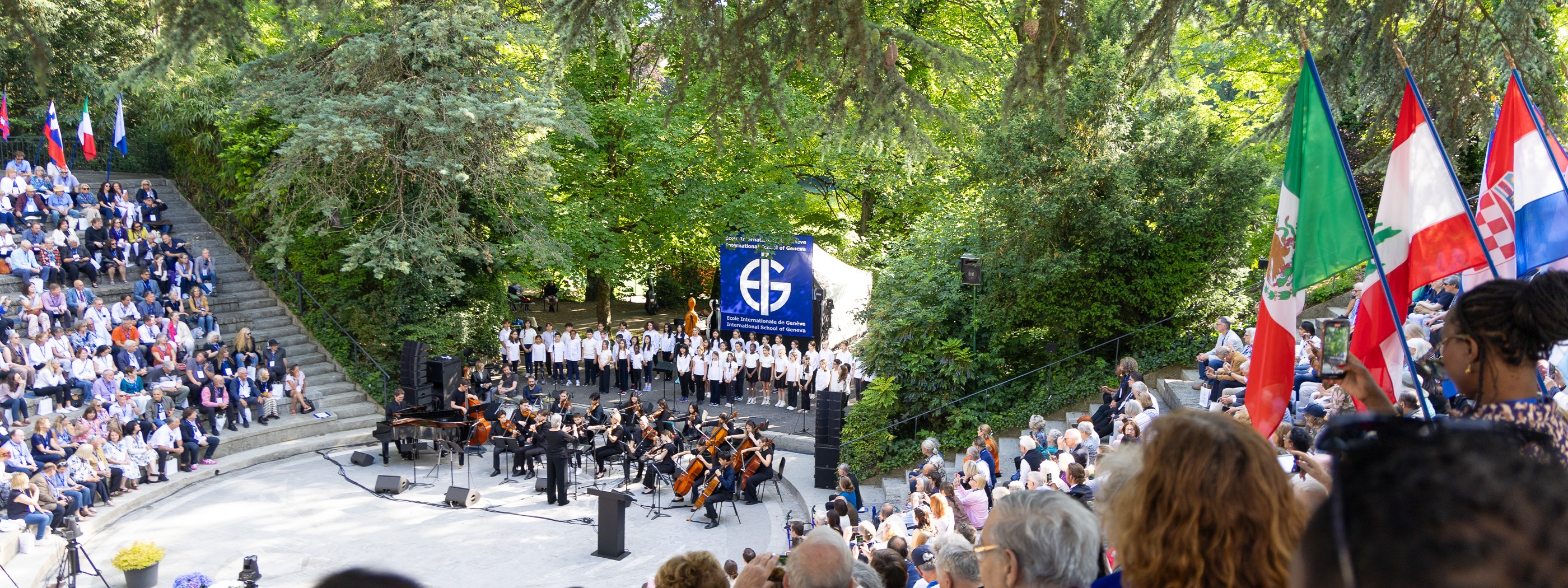
One of the lasting memories I will always have from my days at Ecolint will be that of the construction of the Greek Theatre. This extraordinary project, a brilliant idea that created an iconic landmark of the school, was coming to its completion when I started at Ecolint. It was a wonderful idea since it got everyone on the campus involved in its construction in some way. It gave us all a great feeling of pride, belonging and achievement when we witnessed the last piece of the mosaic depicting the map of the world being placed at the central floor of the theatre. Since that day, all major events of each year, culminating in the very important graduation ceremony, continue to be held here…and I must admit even now, more than six decades later, yesterday while sitting at the Opening Ceremony I felt pride and nostalgia at being part of this piece of history! In fact, it’s the memory of the enthusiasm and motivation of this all-inclusive project that encouraged me later in life to use similar ideas to create team spirit and strengthen bonds of my editorial team. Surely this Ecolint icon will, like the ancient Greek monuments, far outlive its more modern buildings housing labs and classrooms on the campus!
Once I had entered secondary school, I discovered one of the fascinating and major annual events in which I would get involved was the Students United Nations (SUN). Since we represented countries that were in most cases not our own, it gave us a wonderful occasion to experience the thinking of world events in different countries. When you were selected to represent a country as its official delegate it gave you a feeling of importance and made you go and find out all about that country and its policies. One usually ended up going to that country’s mission, discussing the subjects being treated at the SUN that year, and being in a better position to represent the country’s position correctly. This gave me a much broader outlook on world affairs and its diplomatic intricacies. The SUN experience firmly complemented the already solid international foundation we received at Ecolint that in later years made it more possible to understand global issues.
The Ecolint experience, as I knew it at LGB, is something you come to realize decades after leaving school, following much nostalgia and considerable hindsight. While at school one is too busy with the normal daily routine of classes, homework, exams, various activities, the dread of having to roll down the snow-covered outer slopes of the Greek theatre in what Mr. Garstang euphemistically called sports, etc. to think of it all as being a special experience! It is much later in life that it dawns on you that you did have a somewhat privileged upbringing by going to Ecolint. For a start the LGB campus itself was somewhat unique, with its extensive grounds and in being situated within the city limits and easily accessible for us students, without any parental help! It was pretty much self-contained, with several sports fields, various courts and changing facilities, separate buildings for primary, middle and secondary schools, modern science labs, activities workshops and music rooms, an excellent library, a huge assembly hall that also became the dining room and school dance floor. In addition there were separate boys and girls boarding houses. As students, I must admit we all took all this for granted and never thought of it as being something special.
The Ecolint experience, as I knew it at LGB, is something you come to realize decades after leaving school, following much nostalgia and considerable hindsight.
We had very good teachers who came from around the world for the long term, ending up spending most of their professional lives at Ecolint. They got to know each of us very well, our weaknesses and qualities and so knew how to guide us. They were the equivalent of the old family doctors who knew their patients very well. When we were 10- 12-year-olds, the teachers appeared to be quite old, but when I saw that some of my teachers taught my daughters three decades later, I realized they must have been young graduate teachers when they came to Ecolint. In addition to the standard subjects and languages, we also had a wide choice of other interesting subjects like comparative religion, Latin, Greek, Russian, drama etc., and a thriving debating society. All this meant that the Ecolint experience made most of us well-educated broad-minded highly tolerant citizens of the world, something that has helped me greatly in my professional and personal life over the years.
In this context, an incident comes to mind that seemed quite banal at the time, but had its significance later with hindsight. During my university days, we were three friends wandering in downtown Manchester. We were all three of Indian origin, with me a result of the Ecolint experience, the second straight from India and the third having been brought up in South Africa. We came across a large group of kids blocking the pavement and I remarked: ’Looks like a class outing; hope they escape the rain. The friend straight from India observed: ‘There were only 40 kids and as many as six teachers to guide them!’, while the third noted: ‘Did you notice that there were no coloured kids there?’ I later realized how significant our upbringing and the environment in which we grew up influences and shapes our lives and our perceptions.
When I went to England after Ecolint it never occurred to me that I was going there as a foreigner. My multi-cultural upbringing and graduating from Ecolint as a citizen of the world made it easy to fit into local society. In fact, this background has helped me wherever I went around the world, never really feeling I was there as a foreigner, except in those countries where language was an issue. This legacy from my Ecolint days has made it a pleasure to travel and mingle with the locals in most countries. When I arrived at university in Manchester, I was an enigma for the local students: Here I was, a brown guy claiming to be from Switzerland, yet who seemed to fit in with them easily! I must say I never really had any problem being accepted amongst them. In those days there was friendly rivalry between the more working-class northerners and the richer conservative southerners. I was accepted by both sides but ended up having to listen to each other’s grievances! Without being aware of it I must have donned my neutral Swiss hat!
One of the most important things that I learnt from my parents is to always keep an open mind and to have a welcoming house. Both in India and later in Geneva, my brothers’ friends and my friends were always welcome to our house and often my mother spent long moments talking to them and advising them. As a result, she often knew more about their problems, their homework and their activities at school than did their parents! In those days, the Swiss wanted mothers to be available at home to receive their children during lunch and as a result our lunch break was nearly 2.5 hours long…not 45 minutes like now. There was no cafeteria at LGB (except for the interns) and senior students could go across to the Tea Room or Auberge at Grange Canal! Others were expected to go home and, on many occasions my friends who lived too far to go home would come over to our place and thus knew and enjoyed my mother’s cooking! This background gave me a sense of bringing people together, as a ’rassembleur’, which has become stronger with the years. Since I have remained in Geneva (except for my five university years) my place and I have become a point of contact for all alumni of my years transiting through Geneva. In fact, this role served me well at university, where I arranged week-end reunions in London with alumni dispersed all over England. We had to fix the rendez-vous via snail mail and pay phones, so no one could change the meeting times! Our nostalgic moment was meeting at the Swiss Centre at Leicester Square and renewing with fondue, fendant and the inevitable ‘meringues/double crème’! We have now created a tradition of holding alumni reunions at my place in Geneva chez moi!
This role of rassembleur has also helped me at the Maison du Bonheur, where we bring together blind and visually impaired people for a whole range of activities. Lots of these people have been ostracized in many parts of their lives and so tend to stay at home in their secure bubbles. It’s been a real joy to help people come out of their shells and to connect with others who are facing similar challenges. At the Maison du Bonheur, we hold a variety of classes and workshops on creative arts, sculpture, as well as on mobility and orientation. For many people, these are not simply an art class – they can be a form of therapy and inclusiveness. And sometimes, when I am sticking a piece of mosaic on some of the gorgeous photo-frames, etc we make here, I have a flashback to the mosaic of the world map on the floor of the Greek Theatre and the sense of togetherness it represents.
At the Maison du Bonheur, we hold a variety of classes and workshops on creative arts, sculpture, as well as on mobility and orientation. For many people, these are not simply an art class – they can be a form of therapy and inclusiveness.
As I reminisce about my school and university days, I am struck by how different the alumni bonds and communities are in each of these. It was interesting to see the difference in human relations between my Ecolint phase and my period at university. I was surprised to realize that I had remained in touch with only a small handful of very close university friends. Since university was just a point of contact where students from all over came for a few years and then returned to their families or elsewhere there was no attraction to return to Manchester later or to be involved with its alumni. Geneva, on the other hand, was home to most of us during school days, with our families living there and hence after graduation, there was a regular flow of alumni returning home or passing through Geneva. This made it normal to have an ongoing relationship with dozens of alumni. In my case, I’ve noticed that over the years, nostalgia and a sense of belonging to Ecolint and the alumni family increases. Gone are any childhood rivalries and relationship problems, all forgotten or disappeared, such that now we are all friendly siblings of the alumni family eager to meet up again and visit the old alma mater! This spirit of Ecolint is what enables such a huge alumni network to thrive, with anyone feeling free to contact others anywhere around the world and in any walks of life if one is passing through somewhere or needs some information.
In this context, it is with great pride that we note the excellent results Ecolint students continue to achieve over the years and that such a high proportion of them go on to reputable universities all over the world and have ended up in positions of importance in their fields. It says a lot about the high standard of education that has been maintained over the decades and one cannot help feeling good when one hears of an alumnus having achieved something wonderful somewhere! Unfortunately, all my experience with the International School of Geneva has been with the LGB campus and so my talk has been concentrating on this experience, but there is no doubt in my mind that all the other campuses offer similar experiences and obtain similar results.
It is not uncommon in Geneva, when one mentions the International School, to hear comments like: ‘Oh it’s a private school for the rich and the elite!’ It is true that private schools anywhere can be quite expensive since they don’t get any government aid and so have to fend for themselves. I also realized that there is a difference between the main international private schools in Switzerland, which are mostly only affordable by the rich and very rich, and Ecolint. Geneva is lucky in hosting so many international organisations, in addition to the United Nations, as well as many multi-national companies. These organisations and companies in many cases provide an education allowance to their employees, such that the students at Ecolint come from all walks of life and from all income levels of society.
Unfortunately in the case of my wife and myself, our respective employers did not provide us with an educational allowance for our girls. Even though I had been a taxpayer ever since I returned to Geneva and the local education system is extremely good and we could have sent our girls there for free, there was never any thoughts in our minds about doing that and so depriving them of the Ecolint experience that I had enjoyed, even if this meant some sacrifices and belt-tightening on our part. I must say we managed it very well, never getting to the point of not even being able to afford the belt! We sincerely feel that it was all worth it as we now proudly see our girls doing so well in their respective careers and lives in general. In fact, I am certain that if they ever relocate to Geneva they will automatically send their kids to Ecolint as well. And who knows, their teachers may still be there to carry on their good work!
Private schools may come and private schools may go, but we can be sure that Ecolint will go on for ever! Surely it is no easy feat to have reached a hundred years, survived a World War and maintained a high quality of education throughout this period. People with a certain vision set up the school in 1924 and that pioneering spirit has been maintained Private schools may come and private schools may go, but we can be sure that Ecolint will go on for ever! Surely it is no easy feat to have reached a hundred years, survived a World War and maintained a high quality of education throughout this period. throughout these hundred years, with innovative ideas in education originating here in Geneva and being implemented worldwide.
Private schools may come and private schools may go, but we can be sure that Ecolint will go on for ever! Surely it is no easy feat to have reached a hundred years, survived a World War and maintained a high quality of education throughout this period.
Something I really appreciate about Ecolint is it has always had the ambition to spread its learnings about international education far beyond this institution. Other private schools market themselves as being exclusive. But the fundamental raison d’être of Ecolint is to be expansive and to do its part to transform education around the world.
When I was at Ecolint, pioneers like Desmond Cole-Baker and so many of our teachers were spreading the concept of ‘international schools’ around the world and developing the International Baccalaureate programme. When my daughters were at school here, the IB was well established but was still being viewed with a bit of suspicion by universities. People like George Walker continued to lead the way. Now the IB is being taught worldwide and influencing the curricula of non-IB schools as well. Millions of people – most of whom will have never heard of Ecolint – are benefitting from the ideas we have been testing out at this school, and I hope that this is the spirit that continues to guide Ecolint through its second century.
I firmly believe that youth has no age limit! How one feels in one’s mind is more important than one’s physical age. I personally feel I’m a 50-year-old, with all the energy and motivation to continue doing great things with my life. If I had started to think that I was a retired old man approaching 80, there’s no doubt that senility would have set in and I’d be vegetating in an old people’s home by now! Similarly, Ecolint may have just completed its first century with honours, having achieved wonderful things in the field of education. However, since the dynamics are there, as is the momentum, I have no doubt that it will continue this good work for years to come. Two months ago there was a total solar eclipse visible from the North American West coast. This rare event will be visible from Switzerland only in 2081. Thus the sun will continue to shine over Ecolint for decades to come, So let us now welcome in Ecolint’s second hundred years with confidence!
Thank you very much for listening patiently to my ramblings. Hope you have a wonderful period of celebrations and nostalgia over the next few days.
Gowri Sundaram
Geneva, 14 June, 2024.