
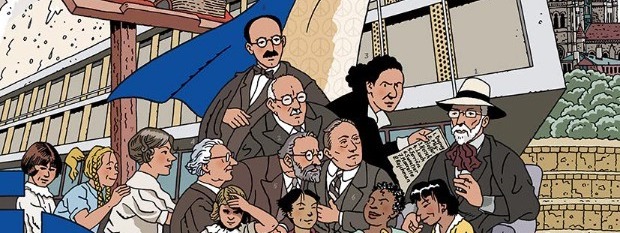
Ecolint’s Centenary poster, by Exem
En français ci-dessous
The poster that Geneva’s bande dessinée artist Exem, real name Emmanuel Excoffier, has created especially for Ecolint’s Centenary is packed with allusions and references that the casual observer might not notice at first glance.
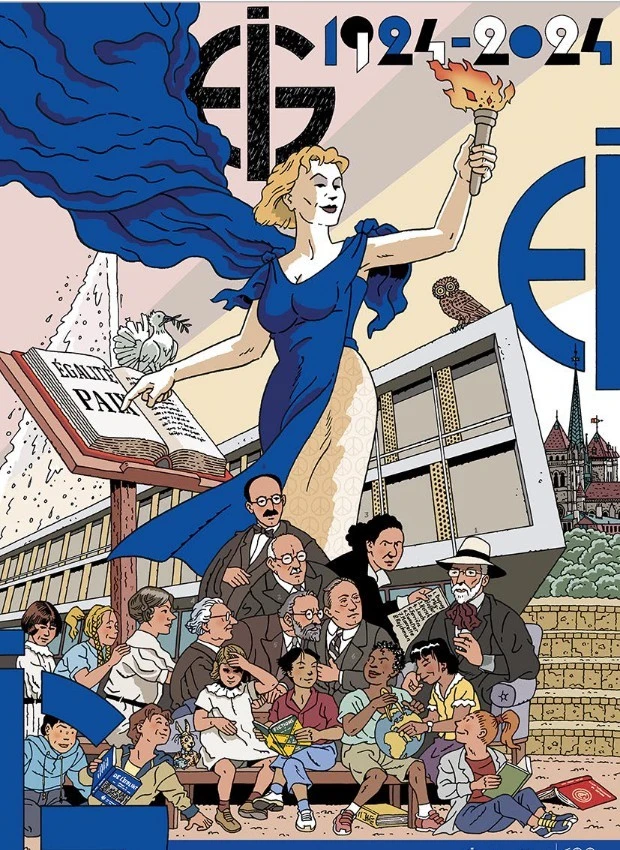
- The allegorical female figure representing Ecolint is inspired by the transition from the Art Nouveau movement, which was still in fashion in 1924, to the novel Art Déco style. The inside of her flowing robe is subtly decorated with the “peace sign” that was originally designed for the Campaign for Nuclear Disarmament (CND) in the late 1950s. She bears a torch symbolizing both liberty and the light shed by knowledge.
- The numbers at the top (1924-2024) are in the cutting-edge Art Déco style, which was just becoming fashionable at the time that Ecolint was founded.
- Behind the allegorical female figure looms the main building of Campus des Nations, representing Ecolint’s purposeful surge into the 21st century.
- Perched on the above-mentioned building and on the volume that proclaims “PEACE” and “EQUALITY” are respectively (a) an owl (representing wisdom) and (b) a white dove holding an olive branch in its beak (representing peace).
- Beneath the presiding figure that incarnates Ecolint are gathered eight key characters in the school’s history. Their pose is inspired by that of the surgeons in Rembrandt’s masterpiece “The Anatomy Lesson of Dr Nicolaes Tulp”:
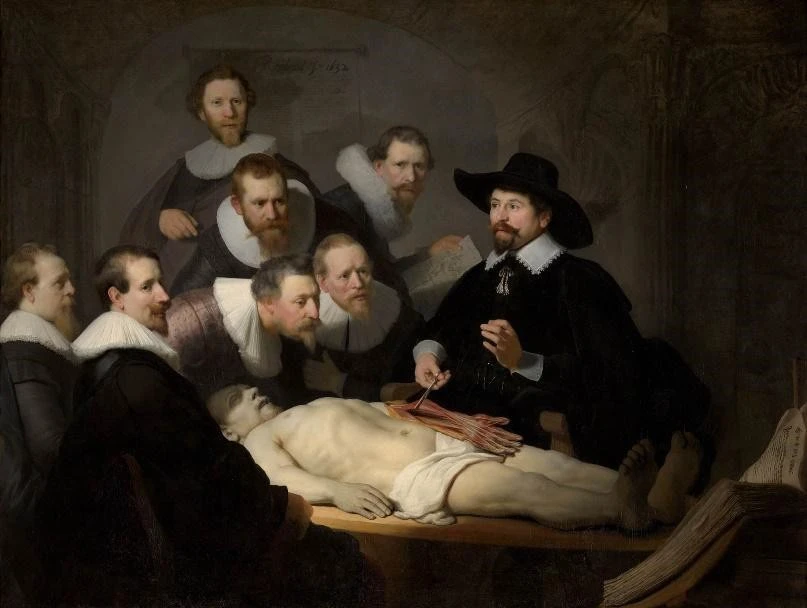
(Happily, the focus of their attention is not a dissected corpse, but two students with a globe of the world!) As in Rembrandt’s painting, the list of those present is being held by one of the characters in the scene – in Ecolint’s case, it’s Jeanne Hersch.
- Each of Ecolint’s eight historical characters is identified by means of a faint number. Jeanne Hersch holds the list with the numbers and matching names. These characters are: (1) Paul Dupuy, (2) Paul Meyhoffer, (3) Jeanne Hersch, (4) Robert J. Leach, (5) Adolphe Ferrière, (6) Arthur Sweetser, (7) Marie-Thérèse Maurette and (8) Ludwik Rajchman.
- Two of the children portrayed are genuine Ecolint students who were present on the first day of school in 1924. Sitting towards the centre of the image, and shading her eyes from the sun, is Loïs Meyhoffer, listed as student number 1 in our historic register. Standing on the far left is Jacqueline Barbey.
- A reference to the rabbit that was also present when the school opened its doors on the 17th September 1924 is the small bust on the bench, next to Loïs. It is, in fact, the March Hare from Lewis Carroll’s Alice in Wonderland (the allusion is completed by the tiny teapot), as originally depicted by the artist John Tenniel.
- Geneva is represented by the Jet d’eau on the left, and the Cathédrale Saint-Pierre on the right.
- Beneath the cathedral, on the right, can be seen some of the steps of La Grande Boissière’s Greek Theatre.
- Three of the books visible can be identified. The one held by the student on the left of the image is De l’Ecolint, by Othman Hamayed and Conan de Wilde, published in 2014. The one lying open on the ground on the right is the history of Ecolint published in 1974 (commonly known as the “Red Book”), to commemorate the school’s 50th anniversary. It was edited by René-François Lejeune. The green-and-yellow book held by the student sitting in the centre of the image is Fictions, a collection of short stories by Jorge Luis Borges.
- The yellow volume lying on the ground, underneath the student who is holding the globe of the world, has the artist’s signature on its spine.
Fill out this form to order a print of the poster
L'affiche du centenaire de l'Ecolint, par Exem
L'affiche que l'artiste de bande dessinée genevois Exem, de son vrai nom Emmanuel Excoffier, a créée spécialement pour le centenaire de l'Ecolint est truffée d'allusions et de références que l'observateur occasionnel pourrait ne pas remarquer au premier coup d'œil.
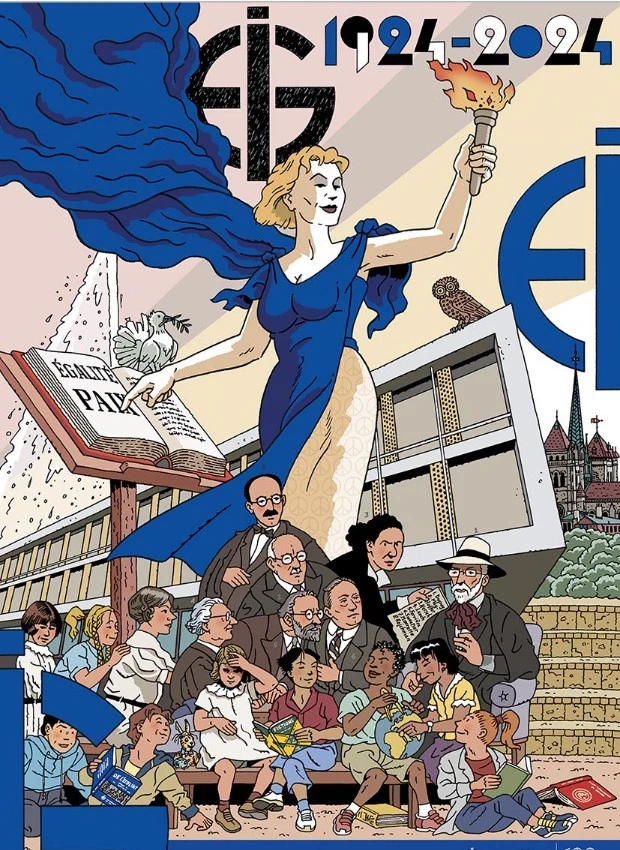
- La figure féminine allégorique représentant l'Ecolint s'inspire de la transition entre le mouvement Art nouveau, qui était encore à la mode en 1924, et le nouveau style Art déco. L'intérieur de sa robe fluide est subtilement décoré du « signe de paix » conçu à l'origine pour la campagne pour le désarmement nucléaire à la fin des années 1950. Elle porte une torche qui symbolise à la fois la liberté et la lumière du savoir.
- Les chiffres du haut (1924-2024) sont dans le style Art déco, qui commençait à être à la mode à l'époque de la création de l'Ecolint.
- Derrière la figure féminine allégorique se profile le bâtiment principal du Campus des Nations, qui représente l'entrée résolue de l'Ecolint dans le 21e siècle.
- Sur le bâtiment susmentionné et sur l’ouvrage qui proclame « PAIX » et « ÉGALITÉ » sont perchés respectivement (a) un hibou (représentant la sagesse) et (b) une colombe blanche tenant un rameau d'olivier dans son bec (représentant la paix).
- Sous la figure magistrale qui incarne l'Ecolint sont rassemblés huit personnages clés de l'histoire de l'école. Leur pose s'inspire de celle des chirurgiens du chef-d'œuvre de Rembrandt La leçon d'anatomie du Dr Nicolaes Tulp :
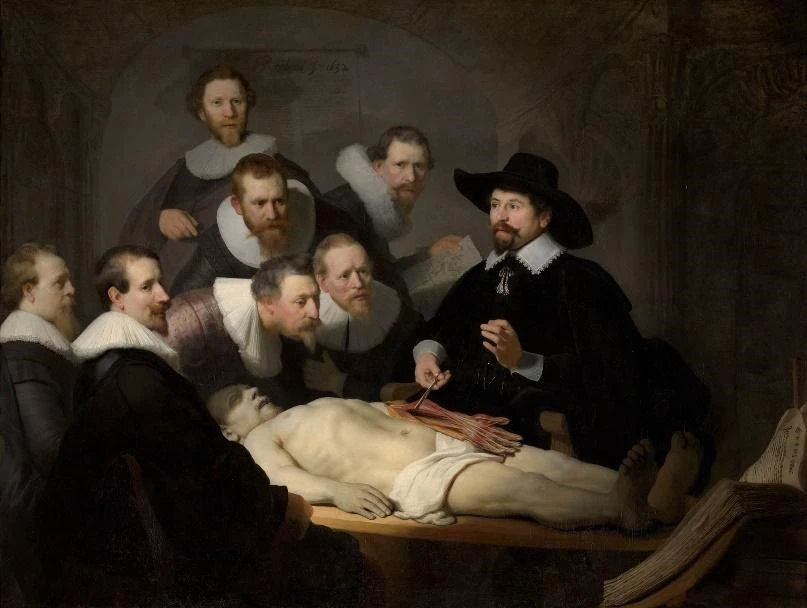
(Heureusement, ce n'est pas un cadavre disséqué qui retient leur attention, mais deux élèves avec un globe terrestre). Comme dans le tableau de Rembrandt, la liste des personnes présentes est tenue par l'un des personnages de la scène - dans le cas de l'Ecolint, il s'agit de Jeanne Hersch.
-
Chacun des huit personnages historiques de l'Ecolint est identifié par un numéro. Jeanne Hersch tient la liste des numéros et des noms correspondants. Ces personnages sont :
(1) Paul Dupuy, (2) Paul Meyhoffer, (3) Jeanne Hersch, (4) Robert J. Leach, (5) Adolphe Ferrière, (6) Arthur Sweetser, (7) Marie-Thérèse Maurette et (8) Ludwik Rajchman. - Deux des enfants représentés sont d'authentiques élèves de l'Ecolint qui étaient présents le jour de la rentrée en 1924. Loïs Meyhoffer, assise au centre de l'image et se protégeant du soleil, est l'élève numéro 1 de notre registre historique. Debout à l'extrême gauche, Jacqueline Barbey.
- Le petit buste posé sur le banc, à côté de Loïs, est une référence au lapin qui était également présent lorsque l'école a ouvert ses portes le 17 septembre 1924. Il s'agit en fait du Lièvre de mars du livre Alice au pays des merveilles de Lewis Carroll (l'allusion est complétée par la petite théière), tel qu'il a été représenté à l'origine par l'artiste John Tenniel.
- Genève est représentée par le Jet d'eau à gauche et la Cathédrale Saint-Pierre à droite.
- Sous la cathédrale, à droite, on aperçoit quelques marches du théâtre grec de La Grande Boissière.
- Trois des livres visibles peuvent être identifiés. Celui tenu par l`élève à gauche de l`image est De l`Ecolint, de Othman Hamayed et Conan de Wilde, publié en 2014. Celui qui est ouvert sur le sol à droite est l'histoire de l'Ecolint publiée en 1974 (communément appelée « Livre rouge »), pour commémorer le 50e anniversaire de l'école. Il a été édité par René-François Lejeune. Le livre vert et jaune tenu par I'élève assis au centre de l'image est Fictions, un recueil de nouvelles de Jorge Luis Borges.
- Le volume jaune posé sur le sol, sous l'élève qui tient le globe du monde, porte la signature de l'artiste au dos.
Remplissez le formulaire pour commander une copie du poster.