
Leonardo Castorina, Science enthusiast, protein dreamer, LGB 2016
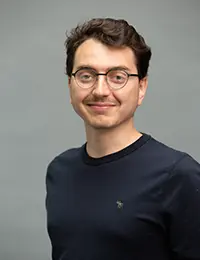
Leonardo Castorina
La Grande Boissière, 2016
Science enthusiast, protein dreamer
Scotland
Find more about me:
- TEDx talk about AI and Health Care
- If you’re interested in learning about proteins, I’ve created a mini-tutorial on how to design and 3D print one. I am planning to record a video soon, but if you have questions in the meantime, feel free to reach out :)
- If you would like to learn more details about the research I do, have a look at my Google Scholar page, especially my paper on TIMED-Design.
The great thing about Ecolint is how it pushes you to engage and collaborate with others. This is essential for learning and solving complex problems.
I live in Edinburgh, in the UK. Currently, I'm about to finish my PhD in AI for Protein Design and continue my work in the industry. Proteins are the architects of life on Earth. They do virtually everything such as photosynthesis, biochemical reactions, and signalling. They are also found everywhere, from the shells of turtles to muscle fibres and elastic tissue.
As the name implies, I design new proteins. These are proteins nature has not yet invented, designed to address important biological problems such as cancers and vaccine development. This involves collaborating with people with very diverse skill sets and writing code to develop proteins and tools.
My best Ecolint memory is probably the beginner-level English class with Mr. Osman during my early years at Ecolint. Back then, it was in a room within the library of the Grand Bâtiment. It was always lighthearted and fun. A lot of my close friends were in that class. Despite our English not being great, we always ended up in deep and complex philosophical discussions. I still miss it!
At Ecolint I learned to appreciate diversity of thought. In my opinion, this is one of the most important skills for the modern world. Problems are becoming increasingly complex. Considering different points of view, especially in multidisciplinary fields, is not only important but necessary. The great thing about Ecolint is how it pushes you to engage and collaborate with others. This is essential for learning and solving complex problems.
If I could, would I do anything differently? It's funny but I would do everything exactly the same. In the International Baccalaureate, I missed my top University choice by 1%. Instead, this led me to study Biochemistry at the University of Edinburgh. Edinburgh is well-known for its Computer Science and AI department. I ended up learning coding alongside biochemistry which prepared me for my PhD. So, don't despair!
As Steve Jobs puts it: "You can't connect the dots looking forward; you can only connect them looking backwards."
My words of wisdom to current students: grades don't matter as much as you think. Spend less time trying to optimise your performance to get the grade you want. Savour learning and learn broadly. Read books about weird things. In the grand scheme of things, the most important skills to have are curiosity and motivation. Oh, and listen carefully in math class!
Anyone can be a scientist, no matter the profession, age, or background. I believe education is the key to achieving this. Specifically, by integrating failure as part of the learning process and by letting learners interact and learn from each other.
My legacy. Of course: to leave the world a better place. I believe that we will need a lot of scientists to achieve this. However, not just the kind that do experiments, but those who have curiosity and motivation to solve problems.
Anyone can be a scientist, no matter the profession, age, or background. I believe education is the key to achieving this. Specifically, by integrating failure as part of the learning process and by letting learners interact and learn from each other.